

I’ve had this letter planned since the first quarter of 2025, but now that it’s time to write it, I have no idea how to do so without going blind from gazing too intently at my own navel. (Nevertheless, she persisted.) At the start of this year, I color-coded a blank editorial calendar. Every empty green cell represented an idea I’d need to bring to life in audio or print.
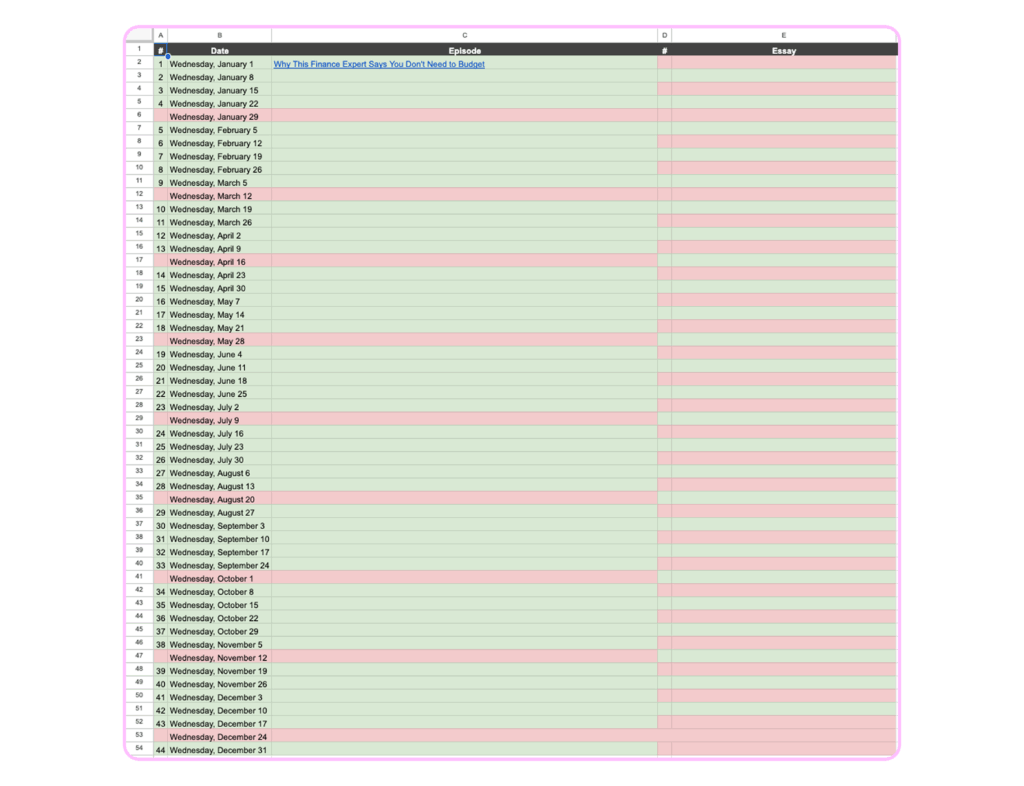
Sometime following the sugar crash of book publication in late June, I slammed into a wall of fatigue. One Sunday afternoon when I was trying (and failing) to write that week’s piece, my frustration spit me out onto the sidewalk surrounding my building, which I paced for the next hour, panicking about the many remaining green cells and few remaining ideas with which to fill them. Moments like those—when empty, slender rectangles glared blankly from the screen—tempted me to abandon my self-imposed publishing goals, always dangling some material regurgitation plan (and related justification) for coasting through the end of the year with less effort.
The barrier to such an approach was that the idea of producing something just for the sake of producing it felt more unbearable than fatigue; worse than pointless. By the time I was crossing the threshold of my apartment again that Sunday night, I had decided that clumsily forging ahead was the only option that would allow me to write this end-of-year letter with a sense of accomplishment. Late into that evening, I wrote “That Funny Feeling.”
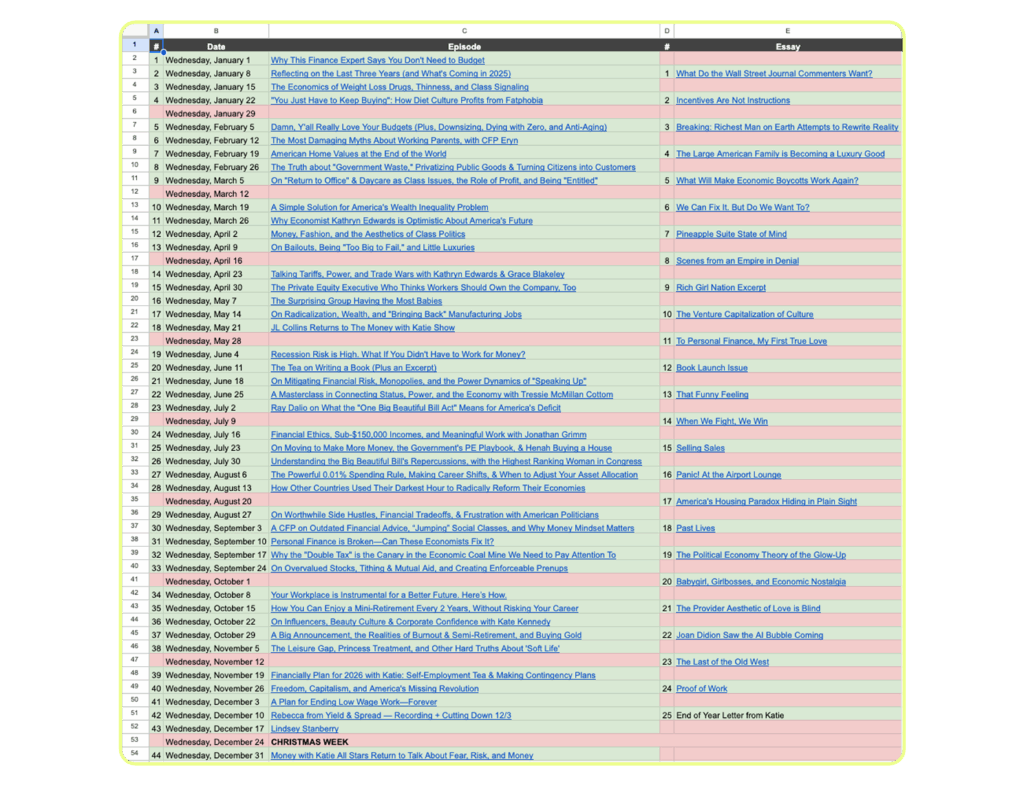
I find myself wanting to thank you, like this is some sort of goodbye speech. Of course it isn’t; after I regain ownership of Money with Katie on January 1, you will continue to receive this newsletter as usual on the first Wednesday of 2026 (although it will no longer come from a Morning Brew email address, and will probably look a little different). Regardless, this remains, in so many ways, the end of an era that changed my life.
Four Decembers ago—when I was approximately two years into self-publishing impassioned screeds about tax planning on my Squarespace website—I made a choice that felt both obvious and risky. Obvious, in that I knew selling my business to a successful media company for a guaranteed income and healthcare was the golden goose I should cage before it wised up and flew south for the winter, but risky in that it would be a dismissal of the altogether different career in UX writing I had just spent the last several years carefully stitching together. My reality at that moment was that there’d be no going back, and it was the sound of doors to other paths clicking shut around me that scored my quiet moments of doubt. (I was right about the “no going back” part, though not in the way I thought.)
On some level, I always suspected building my home within someone else’s mansion was always going to be a long and critical—but ultimately temporary—development strategy. Working on Diabolical Lies (my other podcast, owned by Mouthy Media, which I cofounded in mid-2024) was an undeniable reminder of how addictive it is to build something from scratch with full autonomy. It’s the same compulsion that made the first 20 months of Money with Katie so all-consuming and romantic. This year I finally accepted that the border collie tail-chasing in my mind is a permanent resident, who, without anything to chew on, is liable to start gnawing the furniture. With the big change looming closer, I’ve had a hard time sleeping the last few weeks.
Consciously, I feel hyperengaged and overprepared, like the first day of school is around the corner and mom already sprung for the jumbo pack of G-2 pens. Subconsciously, however, the photonegative of this thrill is deep uncertainty. My body began rebelling in weird ways this summer, shortly after that Sunday afternoon spent wearing the sidewalks thin. My digestive system forgot how to process food. A week-long migraine left me feeling so disoriented that I eventually shuttled myself to the emergency room, where I had a bad reaction to an antipsychotic drug that induced an agonizing restlessness and left me feeling trapped inside my body for hours. (Afterward, I learned this reaction is called akathisia, which can happen with dopamine blockers. My sister-in-law, an emergency room doctor, took one look at my discharge paperwork and said, “I always know when this is happening because the patient rips out their IVs and elopes from the ER.”)
The experience introduced a fear of my own mind that emerged relentlessly over the following months. This past September, I remember sitting in a hotel room in New York City and staring out the window at the cramped skyscrapers across the street as an invisible tsunami of panic began descending. Outwardly, I researched hormonal shifts and began getting acupuncture. Privately, I started to wonder if the last five years were catching up with me, like I had mortgaged my ability and my body was finally calling in the loan.
The decision to stop producing The Money with Katie Show was, in that respect, an obvious one, which announced itself peacefully one afternoon while I did research for an interview. (I don’t remember the topic.) After four years and hundreds of episodes, I think most people would reach a point where they feel they’ve said what they wanted to say; asked the questions worth asking. The show’s numbers have never been better, and it feels gratifying to choose to leave a party while it’s still raging.
At some point around Thanksgiving when I took off three continuous days for the first time since March, the resultant empty cells of my schedule allowed me to notice a pattern in the way I was thinking about and discussing The Future. The Future was a galaxy far, far away where I would commence living my Real Life, while this—this life right now—was like an infinite night before vacation, full of anticipation and projection. It was easy to postpone big decisions, because those were the sort of thing you did in that special occasion of The Future, not in the liminal space of the now. Mostly, I wanted to avoid committing to anything that couldn’t be easily reversed, to prevent any doors from clicking shut. But for what occasion was I waiting? Once I noticed this was how I had been unconsciously orienting, I was horrified. When would this so-called Real Life begin? What if this destination, The Future, did not exist, and instead I was landlocked inside the only life in the solar system, the one I was already living? What then?
This way of relating to reality is not altogether different from the methodology and logic of financial independence (or, if you prefer, boilerplate retirement planning). Your working life is just the diligent dress rehearsal, week after week spent with that favored, amnesiac refrain of adulthood: “After this week, things will calm down.” I will enjoy my life later. I will live how I want to then. For all of 2025, I said, “After this year, things will calm down.” This is another way of saying, Later, when my real life begins, things will feel good.
The prospect of having a more open schedule promises both relief and unease. Relief because I really do want things to calm down; unease because what if, after they do, things do not “feel good?” For me, this is less about feeling good and more about craft. All along, my thesis has been this: With more time, the caliber of my work will improve. It will be better. I will be better. The fear, then, is downstream of finally confronting the outcome of that closely held hypothesis. In some ways, it’s easier not to run the experiment at all: to keep the mastery or contentment or fulfillment preserved in the amber of “someday” means never needing to find out if your theory is nothing more than a comforting mirage. The unrealized promise held at arm’s length is Schrödinger’s life change, representing another lever you could pull, a ready-made explanation for why you are not yet the person you hoped to be. The potential of an untested hypothesis is preferable by far to a negative result.
I can recall only one other time when I felt this same apprehension: four Decembers ago, when my previously cherished hypothesis—if I were doing this full-time and not as a side hustle, it would work—was about to be put to the test. If it failed, I’d be something worse than a failure: a fool in search of a new theory. But because of you, dedicated readers who lend me your attention week after week, gratitude is in order. Your generosity is the reason why I’ve become courageous enough to run the experiment anew. Thank you.